
How to Prepare a Pet Product RFQ: A Buyer’s Checklist
Quick answer: A useful pet product RFQ should identify the product, dimensions, materials, target quantity, branding, packaging, quality-control requirements, destination, and required delivery window. The more clearly these items are defined, the easier it is for a supplier to evaluate feasibility, explain available options, and prepare a quotation based on the same assumptions.
For buyers sourcing pet beds, toys, apparel, travel gear, feeding products, cat furniture, or other pet supplies, an RFQ is more than a request for a price. It is the working brief that connects the commercial idea with product development, production planning, packaging, inspection, and shipment preparation.
As a pet products manufacturer, HBYT uses confirmed project information to coordinate product selection or development, specification review, sourcing and production planning, packaging, quality-control requirements, and shipping readiness. This guide explains what buyers should prepare before requesting a quote.
What Information Should a Pet Product RFQ Include?
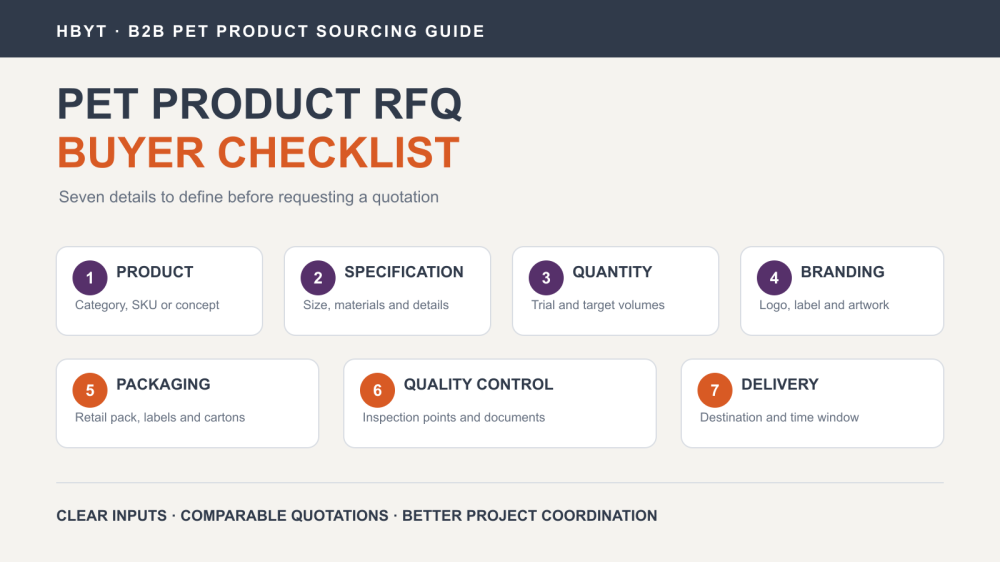
A complete RFQ normally covers the following seven areas:
| RFQ Section | Information to Provide | Why It Matters |
|---|---|---|
| 1. Product | Product category, reference image, SKU, drawing, or concept | Defines the item being evaluated |
| 2. Specification | Dimensions, materials, colors, construction, and performance requirements | Prevents different specifications from being compared as if they were identical |
| 3. Quantity | Trial quantity, target order quantity, and expected repeat volume | Affects material purchasing, production method, and unit-cost structure |
| 4. Branding | Logo method, label, hangtag, color standard, and artwork files | Clarifies private-label and customization work |
| 5. Packaging | Individual packaging, carton requirements, barcode, inserts, and carton marks | Influences cost, packing efficiency, and shipment preparation |
| 6. Quality Control | Inspection points, testing requests, defect criteria, and documentation | Defines how the finished order will be assessed |
| 7. Delivery | Destination, trade term, target ship date, and required arrival window | Supports realistic production and logistics planning |
1. Define the Product Before Asking for a Price
Start with a clear product reference. For an existing item, provide the supplier SKU or a link to the relevant product page. For a custom design, send a drawing, reference image, sample description, or specification sheet and clearly identify which details must remain unchanged.
A product name alone is rarely enough. “Dog bed,” for example, can refer to different shapes, fabrics, filling structures, removable-cover designs, size ranges, and packaging methods. Each variation can change material usage, production steps, carton size, and quotation assumptions.
If several products are included in one project, use a separate line for each SKU. This makes it easier to confirm dimensions, colors, quantities, and packaging without mixing information between items.
2. Separate Required Specifications from Optional Preferences
Mark each requirement as either mandatory or open for recommendation. This distinction allows the supplier to identify where an alternative material, construction method, or size adjustment may be considered without changing the core product concept.
Useful specification details may include:
finished dimensions and acceptable tolerance;
main and secondary materials;
fabric weight, filling type, board thickness, rope diameter, or other category-specific details;
color reference, such as a physical swatch or agreed color code;
closure, stitching, hardware, printing, or assembly method;
size range and quantity by size or color;
performance or inspection points relevant to the product.
When exact material specifications are not yet available, explain the target use, sales channel, positioning, and price range. These details do not replace a specification, but they help the supplier propose options for review.
3. Provide More Than One Quantity Scenario
Instead of asking only for the lowest possible MOQ, provide a trial quantity and one or two target order quantities. For example, a buyer may request an evaluation at 500, 1,000, and 3,000 pieces, subject to the product and customization method.
This approach helps separate fixed development or setup work from volume-dependent production costs. It also allows buyers to compare a market-test quantity with a larger replenishment scenario.
MOQ should be reviewed together with material availability, color selection, logo method, packaging, and the number of SKUs. A quotation for one color and one size cannot automatically be applied to a project divided across many colors, sizes, or packaging versions.
4. Clarify Branding and Private-Label Requirements
Private-label projects should state where the brand appears and how it should be applied. Common requirements include woven labels, printed labels, embroidery, heat transfer, silicone patches, metal plates, hangtags, instruction sheets, packaging artwork, and carton marks.
Provide editable artwork when possible and specify the required logo size, color, and placement. If the final method is not decided, identify the preferred appearance and ask the supplier to explain feasible options for the product and order quantity.
For proprietary designs, confidentiality terms, authorized access, and permitted disclosure should be agreed before detailed files or samples are exchanged.
5. Treat Packaging as Part of the Product Specification
Packaging affects more than presentation. It can change labor, material cost, carton utilization, product protection, labeling, and shipment dimensions. Include packaging requirements in the RFQ rather than adding them after the unit price has been discussed.
Confirm whether the quotation should include:
polybag, paper wrap, color box, display box, or another individual package;
barcode or retailer label;
instruction sheet, warning text, or care label;
inner carton or master carton requirements;
carton marks and shipping labels;
pack quantity and any carton-size limitation.
If packaging artwork is not ready, state whether the supplier should quote a standard neutral package, a custom package, or both.
6. Define Quality-Control and Documentation Requirements
Do not rely on a general instruction such as “good quality.” Identify the characteristics that should be checked and the records the buyer expects to receive.
Depending on the product and order, the RFQ may cover appearance, dimensions, material confirmation, stitching, assembly, function, labeling, packaging, carton quantity, and shipment marks. If the buyer uses an inspection standard or defect classification, it should be provided before production.
Testing and documentation requirements vary by product and destination market. Buyers should identify the applicable requirements for their market and confirm the requested document scope with the supplier before the order is finalized. A material name or marketing description should not be treated as proof of compliance.
7. State the Destination and Delivery Window
A requested ship date is more useful when it is connected to the destination and commercial schedule. State the destination port or city, requested trade term, target shipment date, and any fixed retail or promotional deadline.
The supplier can then evaluate the project sequence, including specification confirmation, sampling, artwork approval, material preparation, production, inspection, packaging, and shipping readiness. Final timing should be confirmed only after the product, quantity, packaging, and approval requirements are clear.
Copy-and-Use Pet Product RFQ Template
Buyer / Company:
Target Market:
Product Name or Supplier SKU:
Reference File or Sample:
Dimensions and Size Range:
Materials and Construction:
Colors and Quantity by Color / Size:
Trial Quantity and Target Order Quantities:
Logo and Branding Method:
Individual Packaging:
Carton and Label Requirements:
Inspection / Testing / Documentation Requests:
Destination and Requested Trade Term:
Target Shipment or Arrival Window:
Additional Mandatory Requirements:
Common RFQ Mistakes to Avoid
Comparing quotations based on different specifications. Confirm that materials, sizes, packaging, and quantities are aligned before comparing unit prices.
Requesting a final price before the product is defined. Early estimates may change when the specification, artwork, or packaging is confirmed.
Combining too many SKUs without a quantity breakdown. Provide quantities by product, size, color, and packaging version.
Adding packaging and testing requirements at the end. Include them in the initial RFQ so the quotation reflects the intended order.
Using an urgent deadline without an approval schedule. Sampling, artwork, inspection, and shipping decisions all need responsible owners and target dates.
Frequently Asked Questions
Can I request a quotation without a finished specification?
Yes, but the result should be treated as an initial evaluation rather than a final quotation. Provide the product concept, intended use, target market, quantity, and mandatory requirements so that available options can be discussed.
Should I send a physical sample?
A physical sample can be useful when construction, hand feel, color, fit, or assembly details are difficult to define in drawings and photos. Before sending it, confirm which characteristics should be matched and which may be changed.
Why does the supplier ask for the destination market?
The destination can affect requested documentation, labeling, packaging, shipping arrangements, and the buyer’s own compliance review. It also helps avoid preparing a quotation around assumptions that do not match the intended market.
Can one quotation include standard and custom options?
Yes. Clearly separate the standard product from each custom option and request itemized pricing where practical. This makes it easier to understand which changes affect development, MOQ, packaging, or unit cost.
What should I do after receiving the quotation?
Review the quotation together with the specification, quantity breakdown, packaging, sample requirements, quality-control scope, delivery assumptions, and payment terms. Any unclear item should be confirmed in writing before the project moves forward.
Prepare Your Next Pet Product RFQ
Browse the HBYT product categories to identify a starting product or SKU. You can also review the wholesale FAQ before sending your project information. When the specification is ready, contact our team with the completed RFQ details for evaluation.